

Kevin Warsh's arrival at the Fed raises questions about the rate trajectory in a context of resilient employment.
In a context of geopolitical conflicts and media squabbles, we will try to sort things out. Today's report deals more with the various policies expected from central banks and the stakes involved. Obviously, we cover the various markets - commodities, equities, or even cryptos - where losses are starting to be felt.
The current momentum seems driven by the new face of the Fed, Kevin Warsh, whose nomination pushed the market to price in a more accommodative stance. However, the dollar remains carried by solid macroeconomic data, creating a tension between political rumors and the reality of production indicators.
1. USD: The Kevin Warsh turning point & the ISM
With a new Fed chairman unveiled last Friday, the United States is decidedly in a dovish momentum. Indeed, Kevin Warsh, initially fairly hawkish, has seen his stance shift over recent years, thus drawing him alongside D. Trump. The market has already priced this appointment into the valuation of the dollar, with a sharp decline in dollar-correlated assets.
Yet, last week, the ISM (manufacturing index) was published well above expectations at 52.6; this value remains the highest since August 2022. Given the Fed’s hawkish tone over the past month, one should expect a real deterioration of the US labor market in order to be able to consider anticipating a rate cut by June.
2. Japan: The Sanae Takaichi era and the end of Yield Curve Control?
At the start of this week, Japanese markets are driven by the landslide election of the Liberal-Democratic Party led by Sanae Takaichi. With a desire for a strong and resilient Japan, Takaichi has restored confidence among domestic and foreign investors alike, translating into a sharp rise in the Japanese market.
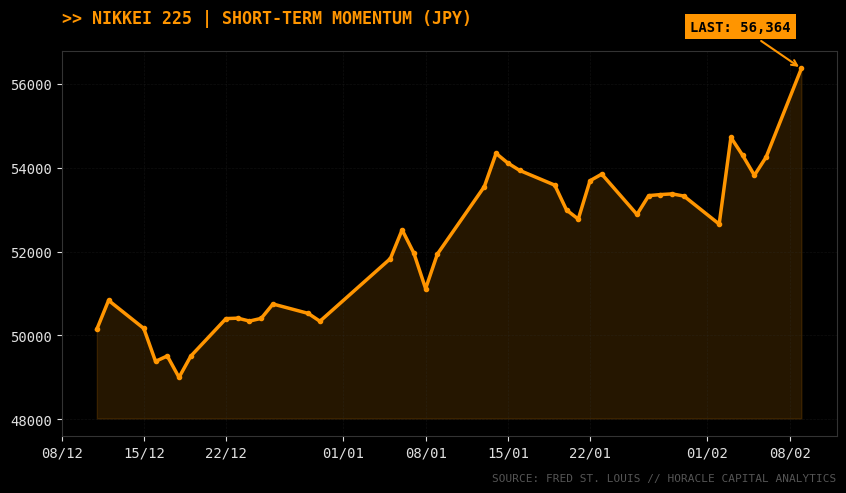
The stakes of these elections are significant: the party’s nomination could steer production toward an expansion phase. This strong appetite for growth would have direct impacts on the inflation rate. Higher anticipated inflation could push the BoJ to raise its rates before long, thereby endangering pairs-trading strategies and favoring an appreciation of the Yen.
3. Analysis by Monetary Zone: Carry Trade and the Division of Central Banks
Euro Area (EUR): A nice start to the week for EURUSD, which reaches 1.189. The ECB's statement underlines inflation close to the 2% target and controlled unemployment (6.2%). For now, the ECB grants itself the right to decide after each meeting without a predefined plan. Watch the COT report, which attests to massive interest (+163,361 LONG contracts), creating a liquidation risk.
United Kingdom (GBP): The tone is a bit more dovish from the BoE, with no change in policy rates, but a tight vote (5-4). We note a strong appetite for AI names that could accelerate productivity.
Australia (AUD): The RBA shows itself hawkish with a hike to 3.85%. It remains dependent on developments in China and Fed policy. Carry-trade relationships could be jeopardized if the Fed keeps rates high for too long.
Canada (CAD): The labor market shows signs of critical fatigue with a loss of 24.8k jobs. This figure places the Bank of Canada in an emergency position to cut its rates, weakening the CAD against a US dollar that remains strong.
4. Commodities & Crypto: Vertiginous fall and the purge of leverage
On commodities, after the ascent came the fall - a more than vertiginous fall last week following Kevin Warsh’s nomination. Nevertheless, precious metals remain fairly resilient with a slight upward retracement at the start of this week.
On the Crypto side, we observe a huge decline with the price of BTC dropping below 70,000. This calls into question confidence in this asset and underlines a massive purge of leverage, impacting the durability of blockchain-related investments.
| Asset | Level / Trend | Observation |
|---|---|---|
| Bitcoin (BTC) | < 70,000 $ | Crisis of confidence and massive deleveraging in the market. |
| Gold | Range | Resilience against the relative depreciation of the dollar. |
5. Equities and Market Sentiment: The AI shock
Tech companies experienced a shock last week, relative to fears linked to AI and its financing. Net short positions remain relatively high on the S&P 500, surely awaiting more conclusive macro results regarding the US labor market.
Trade Ideas & Opportunities
AUD/USD: Watch the strength of US industry. The Warsh effect could limit the AUD's upside despite its 3.85% rate. Risk of a carry trade in jeopardy.
COT report: Euro: record interest with +163,361 LONG contracts. Beware a reversal if US NFP comes in too strong. Yen: probable appreciation following Takaichi's victory. S&P 500: high short positions, the market awaits a deterioration in unemployment to pivot.
Cette analyse a-t-elle été utile à votre allocation ?
Attribuez une note de 1 à 5 étoiles (réservé aux membres Horacle Capital).

Léo Lombardini
Trader, Economics & Quant
Passionate about market analysis and statistical modeling, Léo oversees the strategic allocation of the model portfolio and the development of Horacle Capital's quantitative frameworks, as well as writing weekly articles.
Learn more about the author →Go further with our models
Get the weekly biases of our models by email, or open the full platform.