
SpaceX's record IPO, NVIDIA's RTX Spark superchip, Friday's crash triggered by an all-too-solid US jobs print, and commodities held hostage by geopolitics.
Equities
This week, the equity market kept its eyes glued to the SpaceX IPO. On Wednesday, June 3, billionaire Elon Musk’s company confirmed its intention to carry out the largest initial public offering in history, raising 75 billion dollars on a total valuation of 1.765 trillion.
The roadshow began on June 4, with a listing expected on June 12 on the Nasdaq under the ticker SPCX. The most remarkable feature is the unprecedented allocation mechanism: Musk stated he wanted to reserve up to a quarter of the 75-billion-dollar float for retail investors, explicitly naming in the prospectus 5 online brokerage platforms tasked with the distribution, including Robinhood.
It is a fairly controversial strategy among institutions: some hedge fund managers see in it an excessive reliance by Musk on his fan base to support the price, while others simply plan to buy the shares to resell them into the wave of passive buying that will follow SpaceX’s entry into the major indices. Fundamentally, the S-1 reveals a structural tension that the prevailing enthusiasm tends to mask.
Starlink, which accounts for 61% of revenue and the entirety of operating profit, de facto finances the abyssal losses of the AI segment born from the merger with xAI. At a 1.75-trillion target valuation, the market is being invited to pay today for flawless execution on segments that have yet to prove themselves. The real question, therefore, is not one of momentum - which is real - but of the price at which one agrees to buy it.
NVIDIA: a new AI chip
 Source: NVIDIA / Computex 2026
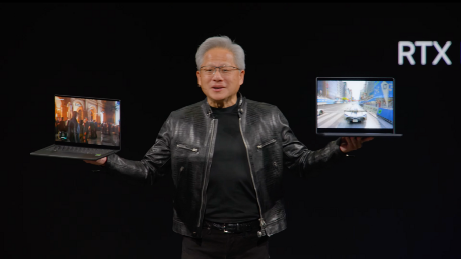
Last week, NVIDIA reported results that continue to defy comprehension. It is on this foundation that this week’s announcement at Computex in Taipei is built. Jensen Huang unveiled the RTX Spark, a superchip designed to reinvent the Windows PC in the age of agentic AI - a clear break from the company’s historical positioning, until now confined to data centers.
The message is clear: NVIDIA no longer wants merely to sell a component, it wants to own everything, from the cloud all the way to the laptop.
The chip comes in two variants: a high-end N1x version packing 20 ARM cores and a more affordable N1 version with 12 cores and 64 GB. But according to Morgan Stanley analysts, this democratization of local AI comes at a price: machines equipped with the N1x should not fall below 2,899 dollars, and those with the N1 below 1,799 dollars - enough to temper the ambition of an “AI supercomputer in every home.” The chip will power laptops from Microsoft, Dell, HP, ASUS, Lenovo, and MSI as early as this fall. Wall Street’s reaction was immediate, with AMD, Intel, and Qualcomm falling right after the announcement, implicitly acknowledging the threat to their core business. In parallel, Huang confirmed that the new Vera CPUs for data centers are in full production, with Anthropic, OpenAI, and SpaceXAI among the first customers - a reminder that dominance over the cloud remains intact, even as the offensive on the edge gets under way.
Yesterday’s crash
 Source: Horacle Capital Analysis
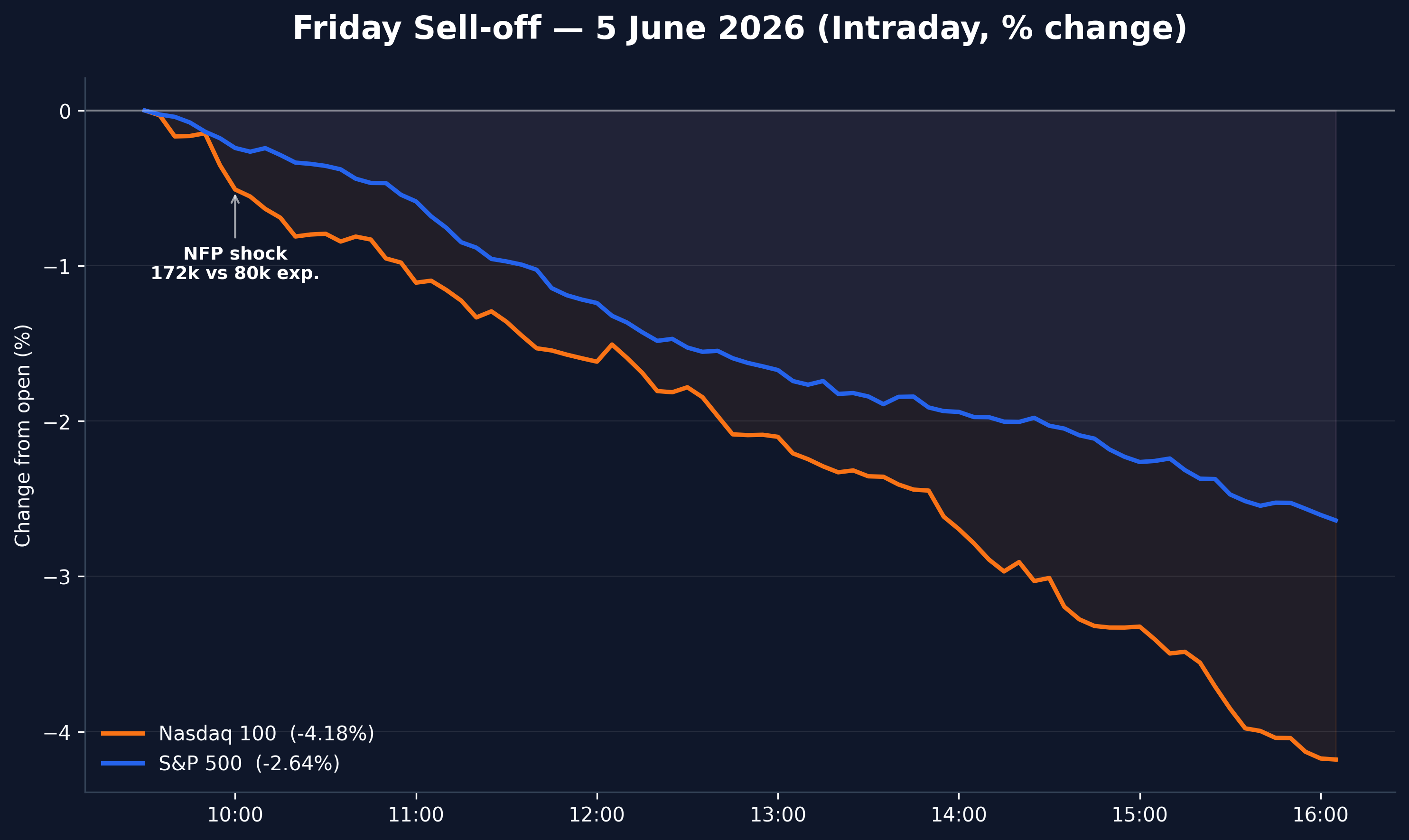
This Friday, June 5, the US employment figures for May were released: they were supposedly good. And that is precisely where the problem began.
172,000 non-farm payrolls created in May, against a consensus of 80,000 anticipated by economists. The US 10-year yield broke through the 4.5% threshold, while the 30-year settled above 5% - levels that mechanically revive the question the markets had forgotten: if the economy stays solid, the Fed has no reason to cut rates. And durably high rates are a bottleneck for the US economy.
Another problem: Broadcom reported its quarterly results. The company missed revenue expectations and, above all, did not raise its outlook on AI chips. It was therefore a major disappointment. Broadcom lost more than 6% on Friday, after already shedding 12% the day before. Marvell Technology and Micron fell 12% and 11% respectively.
The result: the Nasdaq lost 4.18%, closing at 25,709 points, its sharpest drop since the tariff turbulence of April 2025. The S&P 500 declined 2.64% to 7,383 points, and the Dow Jones gave up 695 points, or -1.35%, to finish at 50,866 points.
Commodities
Oil
Oil was rather contradictory this week. On one side, exchanges of strikes between US and Iranian forces revived fears of lasting disruptions in the Strait of Hormuz. On the other, on Friday, Trump struck a more optimistic tone, raising the prospect of a swift reopening of the strait if Tehran agreed to a memorandum on the cessation of hostilities. The market, hard to convince, absorbed the statement with caution. WTI (West Texas Intermediate) pulled back toward 91 dollars on Friday, extending a 3% drop from the previous day, while Brent slipped below 94 dollars, all while remaining, over the week, more than 4% above its Monday levels.
Gold
Gold, for its part, is going through a more uncomfortable phase. The metal had made a spectacular run since the start of the year: more than 6% in gains in just thirteen trading days in January, after a 64% rise in 2025, driven by massive central-bank buying and safe-haven demand. J.P. Morgan now targets an average price of 5,055 dollars an ounce in the final quarter of 2026. But on Friday, the dynamic worked against it: a solid US jobs print, rising bond yields, a strengthening dollar. As one market analyst summed it up: “Gold needs the war to end in order to rise, not to escalate.”
A classic paradox: the war in the Middle East that fuels inflation forces the Fed to keep its rates high, which weighs on gold. The metal is held hostage by the very conflict that should send it soaring. The result: 4,328 dollars an ounce, a solid performance, but well below what such an unstable environment could have offered it.
Cette analyse a-t-elle été utile à votre allocation ?
Attribuez une note de 1 à 5 étoiles (réservé aux membres Horacle Capital).

Raphaël Chouraqui
Writer
Passionate about economics and market finance. Raphaël brings his expertise in decoding macroeconomic cycles and contributes to writing Horacle Capital's analyses.
Learn more about the author →Go further with our models
Get the weekly biases of our models by email, or open the full platform.