
Analysis of the rotation towards safe havens, the resurgence of tension in the Middle East and the risks of imminent intervention on USD/JPY.
The week proved to be particularly volatile, marked by significant sell-offs in the technology stock market, which favored a strong return of safe-haven assets. Concurrently, renewed tensions in the Middle East and the uncertain political landscape in the UK, following Keir Starmer's unexpected resignation, are adding multiple layers of complexity to the macroeconomic environment. Central Banks, for their part, are staying the course despite sometimes divergent economic data.
1. USD:
The skirmishes in the equity market, particularly in AI and tech stocks, have pushed safe-haven assets such as the dollar, the Swiss franc, and the JPY to appreciate given their role as “safe haven” currencies.
At the end of the week, Iran launched 4 drones against ships present in the Strait of Hormuz, resulting in a challenge to the ceasefire agreements implemented just over a week ago. The opening of the Asian market pushed oil slightly higher, with Brent gaining nearly +2%.
US Fed funds rates also remain quite high, with consequences for the equity market and valuations.
This week the USD/JPY pair was subject to multiple interventions by Japan. Intervention risks remain relatively high in this regard, given the macroeconomic data expected this week for the greenback. If the Non-Farm Payrolls (NFP) were to come in well above expectations, thereby pushing the dollar higher, the probabilities of intervention by Japanese authorities could be revised upwards.
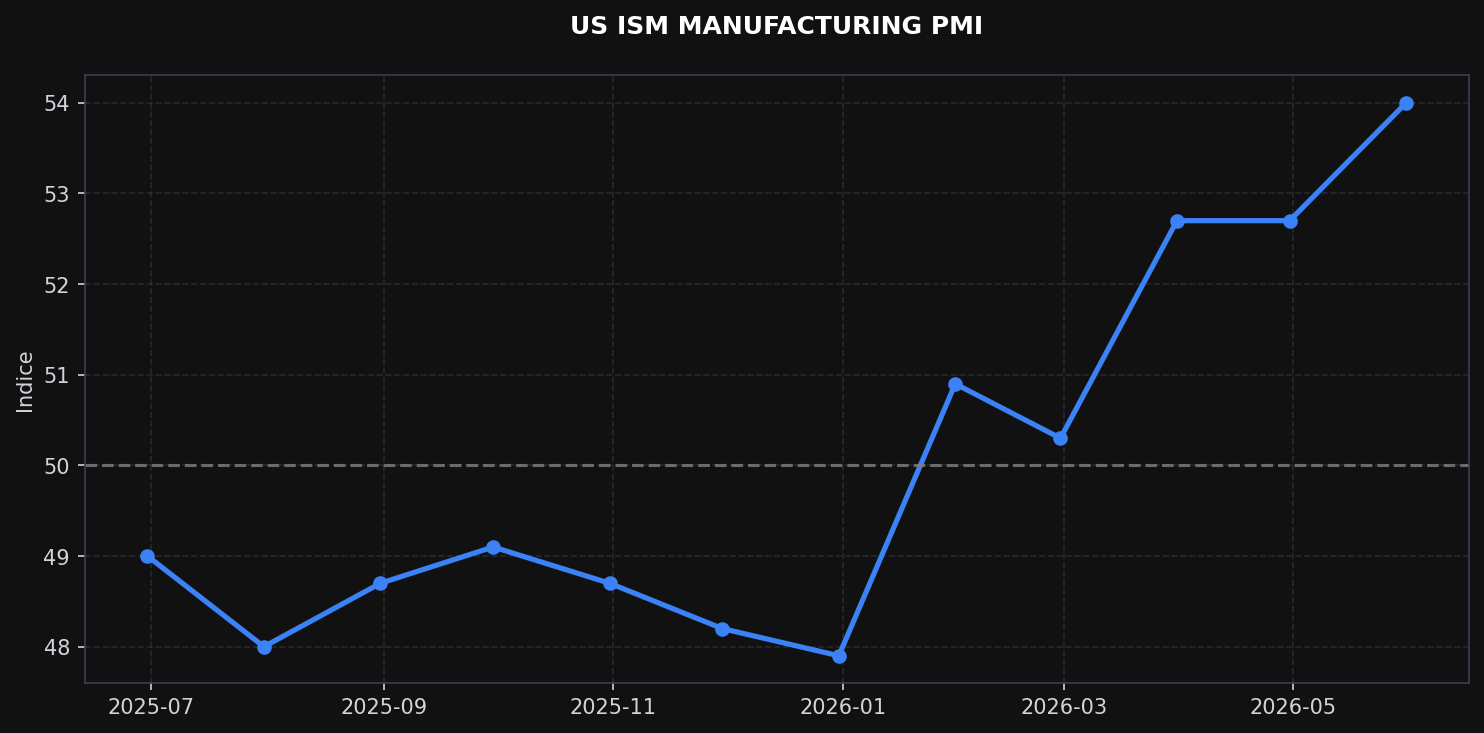
PMIs came in higher than expected in the US, signaling surprising manufacturing resilience despite restrictive financial conditions.
2. EUR:
On the euro front, the past week was enlivened by some macroeconomic data, but without extreme surprises. Indeed, PMIs came out quite strong for France and average for Germany, with no significant warning signals.
The ECB’s tone still remains hawkish (restrictive), even though it is confident that inflation could return to its 2% target in the medium term. The market has lowered the chances of a rate hike in July, from 17% to 10% this week. Furthermore, the market is beginning to price in a 19 bps hike for Q3 2026 by the ECB; these figures will need to be monitored, naturally following the release of inflation and employment data.
The EUR/USD cross is now significantly driven by flows in the US and European equity markets, even though key macro data are still on investors’ watchlists. Indeed, last week, the stock market sell-off had a strong impact on the pair, which has been primarily influenced lately by the dollar’s bullish momentum and the greenback’s data/flows.
3. GBP:
Last week, UK PM Keir Starmer resigned. The former leader of the UK Labour Party tendered his resignation last Monday. The stakes for the United Kingdom are multiplying: given the negative impact of post-Brexit measures, and of Brexit itself, the country is struggling to recover. To replace him, the Mayor of Manchester is the leading candidate. Indeed, Burnham has been designated as the most likely contender for the role of Prime Minister.
This Monday, and in the vein of last week, the GBP and gilts dropped, as the market is already aware of the impacts of various fiscal measures on UK activity. Indeed, since Brexit, the UK has struggled to cope with minor policy changes (especially fiscal ones), frequently triggering large movements in the pound and the relevant bonds.
4. JPY:
As we have covered for a month now, and in the first paragraph of this article, interventions on USD/JPY, via the sale of US treasury bonds, remain increasingly frequent, and the trigger price appears to have shifted.
Indeed, the “danger” zones are now around the 162 and 163 levels for the USD/JPY cross. Given the macro data expected this week, it is not impossible to see a Japanese intervention on the pair, so these key levels should be watched this week (or even this month).
Conversely, as we suggested earlier, safe havens appreciated during the bearish equity market rally, notably the Swiss franc and the yen. Given that further turbulence could still emerge, especially with announcements relating to a Fed rate hike or an overly hawkish tone, the JPY or CHF pairs could be attractive for hedging purposes.
5. NZD/AUD:
The Aussie and Kiwi are the currencies most impacted by the semiconductor market, with the Australian dollar having the highest G10 correlation to the Philadelphia Semiconductor Index.
The RBA (Reserve Bank of Australia) is keeping a close eye on inflation figures, which, overall, remain stable even though core average inflation experienced a slight increase, going from 3.4% to 3.6%. For AUD/XXX crosses, the movement will be impacted by the quality of Australian fundamentals, especially for the AUD/USD pair which suffered a sharp decline last week, given the downward movement in the US equity market.
Written by Léo Lombardini
Cette analyse a-t-elle été utile à votre allocation ?
Attribuez une note de 1 à 5 étoiles (réservé aux membres Horacle Capital).

Léo Lombardini
Trader, Economics & Quant
Passionate about market analysis and statistical modeling, Léo oversees the strategic allocation of the model portfolio and the development of Horacle Capital's quantitative frameworks, as well as writing weekly articles.
Learn more about the author →Go further with our models
Get the weekly biases of our models by email, or open the full platform.