

Global Context
The second week of October 2026 highlights a deepening macroeconomic and financial decoupling across the Atlantic. While the U.S. economy continues to absorb restrictive credit conditions, European manufacturing is mired in stagnation, exacerbated by sovereign political and fiscal risk premiums on government debt.
In foreign exchange markets, the U.S. dollar is firmly entrenched at its yearly highs, with the DXY index breaking above 102.00. This upward momentum is reinforced by hawkish FOMC minutes and resilient real yields on Treasuries. Conversely, the euro faces persistent downward pressure, penalised by widening sovereign spreads and a collapse in manufacturing orders.
Markets now face a sequence of pivotal catalysts for the week of October 12-17: U.S. CPI inflation and speeches by Christine Lagarde on Wednesday, October 14, followed by U.S. retail sales and the Producer Price Index (PPI) on Thursday, October 15, leading into a highly anticipated address by Federal Reserve Chair Kevin Warsh on Friday, October 16.
United States
U.S. macroeconomic momentum remains bolstered by resilient aggregate demand, leaving monetary authorities with little room for premature easing amid sticky residual inflation.
The official minutes of the latest FOMC meeting reaffirmed a firm stance across the Board of Governors. A majority of participants views the current 4.00% federal funds rate as only moderately restrictive on corporate capital allocation. This diagnosis aligns with empirical estimates by Vasco Cúrdia at the Federal Reserve Bank of San Francisco, which place the medium-term real natural rate of interest (r*) around 1.5%. Accounting for core inflation above 2.5%, the prevailing policy rate sits close to strict neutrality, precluding any urgency for premature rate cuts.
This persistent domestic momentum is supported by the quarterly CFO Survey, where corporate wage growth expectations for 2026 remain anchored at 4.0%. Although hiring momentum is cooling and consumer credit expansion is moderating (+$8.3 billion in August vs $12.1 billion in July), the RCM/TIPP Economic Optimism Index rebounded to 46.8, indicating the absence of an abrupt retrenchment in household demand.
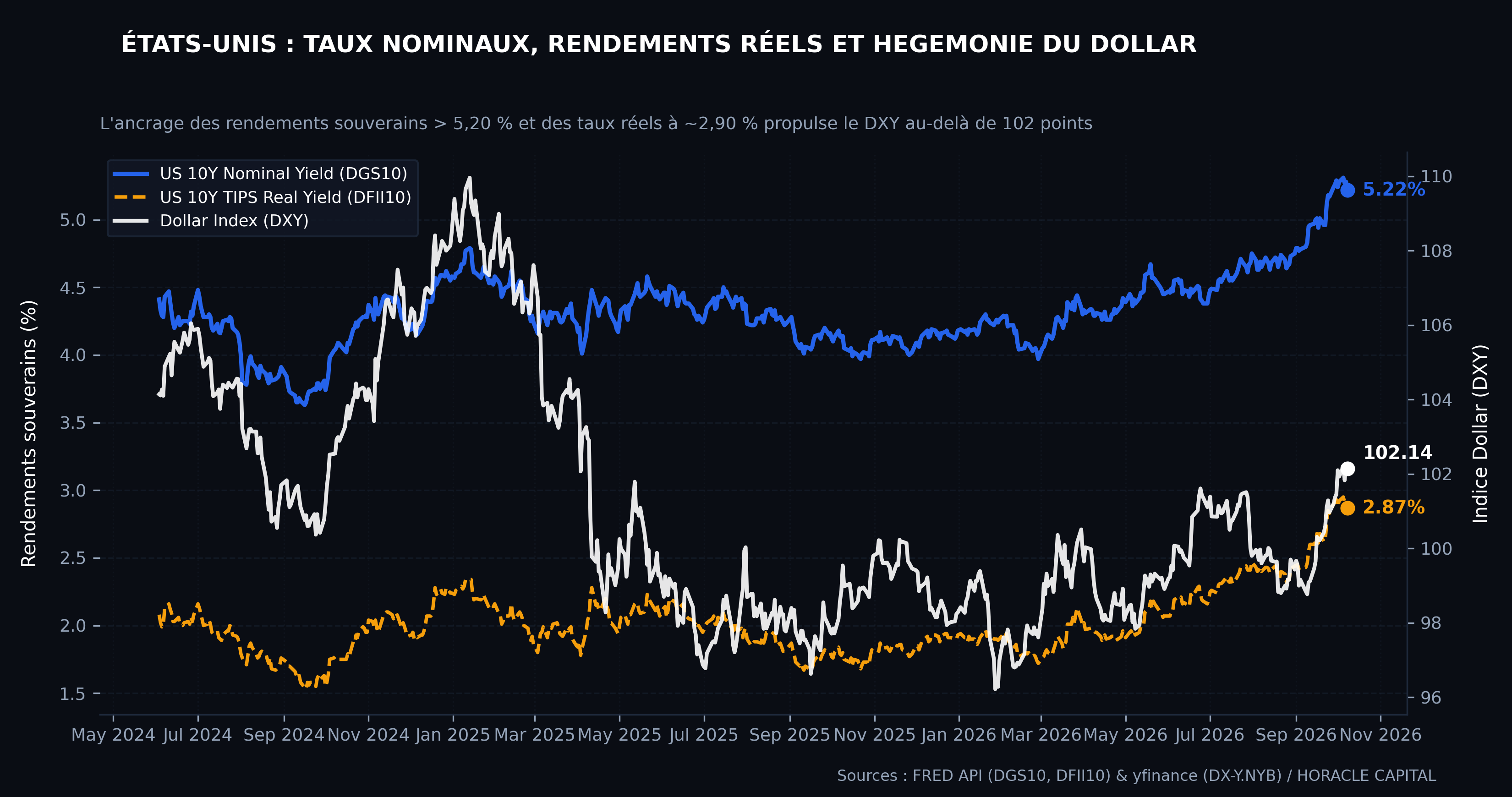
Comparative evolution of the U.S. 10-year yield (5.22%), TIPS real yield (2.87%), and the DXY Dollar Index (> 102.00). Sources: FRED API (DGS10, DFII10) and yfinance (DX-Y.NYB).
This environment makes Treasury yields highly sensitive to upcoming macroeconomic data. The key inflection point will be September’s Consumer Price Index (CPI): consensus anticipates headline inflation accelerating to +0.6% MoM, pushing the annual rate to 3.6% (from 3.4% previously) due to transportation and refining costs, while Core CPI is projected at +0.2% MoM and 2.5% YoY. Confirmation of this headline acceleration would validate persistent inflation pressures and cement the 10-year yield above 5.30%, bolstering dollar dominance.
This assessment will be complemented by retail sales and PPI releases. Markets expect consumer spending growth to moderate to +0.3% MoM (following +1.2% previously), contrasting with solid headline PPI gains of +0.5% (+0.3% Core). Such a divergence between cooling final demand and stubborn industrial costs would signal corporate margin compression, while initial jobless claims steadying around 195,000 would confirm underlying labor market strength. Finally, Chair Kevin Warsh’s speech at week’s end will offer essential guidance on balance sheet runoff and the balance between restrictive policy and smooth Treasury auction absorption.
Euro Area
The European bloc is navigating heightened vulnerability, marked by synchronized manufacturing weakness and widening sovereign risk premiums on French public finances.
The most striking data point of the week was a 10.6% plunge in German factory orders for August, reflecting capital goods investment contraction and structural competitiveness headwinds from sustained energy costs. While German industrial production saw a technical rebound of +2.0% driven by clearing legacy order backlogs, contractions in France (-0.3%) and Italy (-1.3%) confirm broad-based manufacturing sluggishness.
On the fiscal front, the French state budget deficit widened to a cumulative -159.6 billion euros through August 2026, compared to -145.9 billion a month earlier. This deterioration comes amid intense parliamentary friction surrounding the draft budget bill. As highlighted by CEPR research (Bianchi, Lettau, and Ludvigson), potential fiscal dominance is beginning to influence German inflation expectations, which increasingly incorporate the risk of constrained ECB policy discipline to limit debt-servicing strains in Southern Europe.
Against this backdrop, upcoming ECB interventions carry strategic significance. Christine Lagarde’s two planned speeches will be scrutinized to assess whether the governing council prioritizes fighting imported price pressures or whether fears of financial fragmentation and an uncontrolled blowout in the French OAT-Bund spread force policy restraint. Such restraint would strip the euro of carry support against the greenback. Meanwhile, remarks from Swiss National Bank Chairman Martin Schlegel will provide insights into how Swiss authorities manage safe-haven flows during European fiscal and political stress.
Japan
Japan continues its transition toward monetary normalization, underpinned by evidence of entrenched wage growth and private capital investment across its industrial base.
Preliminary machine tool orders jumped 60.4% year-over-year in September, signaling vigorous equipment modernization focused on automation and semiconductor manufacturing. Simultaneously, Ministry of Health, Labour and Welfare statistics showed nominal cash earnings up 3.8% YoY in August. This trend reinforces the Bank of Japan’s view of a virtuous wage-price spiral, even as household consumption remains subdued (-3.1% in volume) due to imported food and energy inflation.
In the rates market, inflation swaps on Japanese government bonds indicate long-term inflation expectations firmly anchored above 2.0%. However, central bank patience and a massive nominal yield deficit against U.S. Treasuries continue to weigh on the yen, keeping asset allocators defensively positioned on yen-denominated holdings.
China
Chinese authorities maintain a careful balancing act, combining targeted liquidity injections with international trade channel management to cushion the property downturn.
The People’s Bank of China left its Loan Prime Rates (LPR) unchanged at 3.00% for the 1-year tenor and 3.50% for the 5-year. The central bank also injected 51.5 billion yuan via 7-day reverse repos at 1.40%, absorbing post-Golden Week liquidity pressures. New home prices continued their downward adjustment (-0.17% MoM), obliging state banks to exercise rigorous underwriting discipline.
On trade flows, a structural study from the Peterson Institute for International Economics (Bown & Auclair) highlights the rerouting of goods: while Chinese-reported exports to the U.S. declined by only 4% relative to benchmarks, direct U.S. imports dropped by 26%. This $109.7 billion discrepancy is explained by extensive physical rerouting through third countries: Vietnam alone absorbs nearly 57% of these transshipments, allowing exporters to circumvent an effective average tariff rate of 24% and preserve current account surpluses.
Sovereign Bond Markets
International government bond markets are operating in a regime dictated by expanding term premiums on long-dated maturities amid historic sovereign issuance volumes.
In the United States, Treasury auctions for 10-year and 30-year paper were met with cautious bidding, clearing at 5.30% and 5.31% with notable concession tails. Decomposition via the New York Fed’s Adrian, Crump, and Moench (ACM) model demonstrates that the 10-year yield holding above 5.20% is primarily driven by expanding term premiums rather than rising breakeven inflation. Investors are demanding structural compensation for the Treasury’s $628 billion net borrowing program slated for the fourth quarter.
This vulnerability is analyzed by the Bank for International Settlements (BIS Bulletin No. 136), which warns of heightened Treasury market dependence on non-bank financial intermediaries (NBFIs), particularly hedge funds executing the basis trade between futures and cash bonds. Compressed swap spreads have incentivized leveraged players to absorb a dominant share of long-end paper, creating liquidity fragility in the event of volatility spikes around CPI releases or upcoming auctions.
In Europe, sovereign curves reflect the absence of unconditional ECB support. Under ongoing Quantitative Tightening, sovereign spreads are re-establishing risk discipline: the French OAT yield spread over Bunds fluctuates between 110 and 125 basis points, reflecting market scrutiny of France’s fiscal trajectory.
Foreign Exchange Markets
Currency markets mirror capital flows attracted by higher yields and U.S. economic momentum.
The DXY index is consolidating above 102.00, approaching technical resistance highlighted by ING FX strategists Chris Turner and Francesco Pesole. Their tactical model emphasizes a very high bar for a meaningful dollar correction, as institutional allocators view the greenback as the natural recipient of a 4.00% nominal carry accompanied by relative insulation from European manufacturing strains.
EUR/USD remains confined in a downward trend below 1.1460. Quantitative analysis from ING reveals that the euro now incorporates a specific discount tied to French sovereign risk (French fiscal risk premium). ING’s Short-Term Financial Fair Value Model has revised the pair’s equilibrium lower, driven by widening 2-year swap differentials favoring the dollar. Upside flows on the euro remain capped by potential sovereign rating downgrades and the prospect of monetary policy constrained by weakening growth.
Among Asian currencies, USD/JPY continues to probe resistance above 156.00. Despite firmer Japanese wage statistics, wide carry differentials hinder a sustained yen recovery, leaving traders alert to Ministry of Finance rate checks if volatility accelerates. Commodity currencies will track Australian employment figures on Thursday, October 15 (+20,000 expected, 4.6% unemployment rate) for guidance on the RBA’s stance against dollar strength.
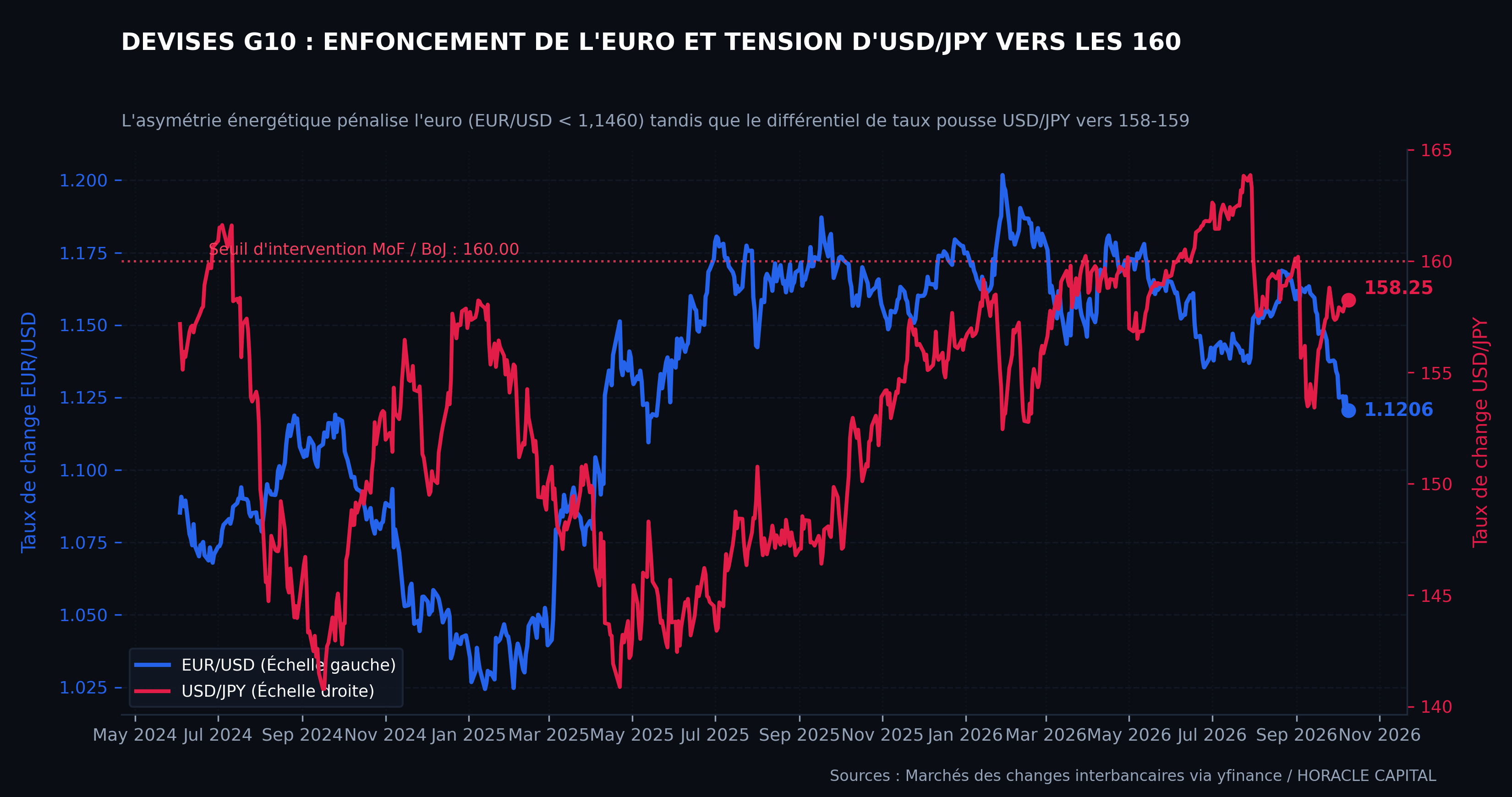
G10 FX Divergence: downward consolidation on EUR/USD below 1.1460 and sustained firmness on USD/JPY above 156.00. Source: Interbank markets via yfinance.
Conclusion
Market pricing at the close of the second week of October 2026 confirms the predominance of the U.S. dollar and an environment of restrictive long-term sovereign rates. Driven by private capital expenditures and a solid labor backdrop, the U.S. economy is absorbing monetary tightness without faltering, deferring rapid Fed easing expectations.
Conversely, Europe remains squeezed between industrial order contractions and fiscal slippage that tests the credit standing of core sovereign issuers. This macroeconomic divergence structures foreign exchange markets, keeping the euro pressured and supporting the greenback.
The upcoming week will be decisive. U.S. CPI inflation and Christine Lagarde’s remarks on October 14, followed by retail sales and Kevin Warsh’s address, will provide empirical clarity on whether the dollar can break to fresh annual highs and whether sovereign curves will extend their term premium expansion.
Sources & References
The analyses, statistical models, and market data presented in this report rely on the following official publications and institutional research:
- ING Think FX Research (Chris Turner, Francesco Pesole, Frantisek Taborsky): FX Daily: High Bar for Correction, French Fiscal Risk Premium and G10 Short-Term Financial Fair Value Models.
- Federal Reserve Bank of New York: Tobias Adrian, Richard Crump & Emanuel Moench, Pricing the Term Structure with Linear Regressions (ACM term premium model); Henry Dyer & Michael Fleming, Market Depth and Liquidity in the U.S. Treasury Market, Liberty Street Economics.
- Federal Reserve Bank of San Francisco: Vasco Cúrdia, Estimating the Natural Rate of Interest (r*), FRBSF Economic Letter; Stephie Fried, The CFO Survey: Business Spending and Wage Expectations; Jens Christensen et al., Inflation Swaps in the Japanese Bond Market.
- Bank for International Settlements (BIS): Mathias Drehmann & Sonya Zhu, BIS Bulletin No. 136: Non-Bank Financial Intermediaries and Market Resilience in Government Bond Markets; BIS Quarterly Review.
- Peterson Institute for International Economics (PIIE): Gregory Auclair & Chad Bown, Trade Diversion and U.S.-China Statistical Decoupling via Third Countries; Karen Dynan & Adam Posen, U.S. Growth and Tariff Persistence.
- Centre for Economic Policy Research (CEPR / VoxEU): Bianchi, Lettau & Ludvigson, Fiscal Dominance and Inflation Expectations in the Euro Area.
- Economic Calendar & Consensus Data: Forex Factory Calendar (CPI, PPI, Retail Sales, Unemployment Claims for October 2026), Bureau of Labor Statistics (BLS), U.S. Census Bureau, Eurostat, Deutsche Bundesbank, Banque de France, Agence France Trésor (AFT), Ministry of Economy, Trade and Industry (METI), Bank of Japan (BoJ), and interbank feeds via yfinance.
Cette analyse a-t-elle été utile à votre allocation ?
Attribuez une note de 1 à 5 étoiles (réservé aux membres Horacle Capital).

Léo Lombardini
Trader, Economics & Quant
Passionate about market analysis and statistical modeling, Léo oversees the strategic allocation of the model portfolio and the development of Horacle Capital's quantitative frameworks, as well as writing weekly articles.
Learn more about the author →Go further with our models
Get the weekly biases of our models by email, or open the full platform.