

Global Context
The transition between the third and fourth quarters of 2026 is marked by a sharp recalibration of market expectations across global financial centers. Trading has been characterized by sustained tightening in international financial conditions, persistent energy supply bottlenecks, and widening cyclical divergences among major developed economies.
While the first half of the week saw global sovereign bond yields test multi-year peaks (with the U.S. 10-year yield reaching 5.20% on rising real yields and aggressive central bank rhetoric), the release on Friday, October 2, of a U.S. employment report far below consensus abruptly tempered expectations of an immediate October rate hike. Simultaneously, the euro area faces a sharp resurgence in headline inflation to 3.8%, driven by Brent crude holding above $100 and an acute middle distillate refining crisis where global crack spreads are breaking all-time records.
United States
The U.S. economy delivered conflicting signals throughout the week, presenting investors with a clear divergence between resilient underlying consumer demand and early tangible signs of labor market cooling.
Early in the week, macroeconomic data reinforced a tightening bias. The upward revision of second-quarter GDP to 2.2% annualized, solid consumer spending growth (+0.8% MoM), and an acceleration in the Core PCE price index to 0.3% confirmed robust domestic demand. This picture was underscored by hawkish commentary from several Federal Open Market Committee (FOMC) members. Beth Hammack warned of the danger of an inflationary mindset becoming entrenched after five consecutive years of price growth above the 2% target, arguing that a 4.00% fed funds rate does not adequately constrain corporate capital spending. Thomas Barkin and Alberto Musalem supported this view, advocating proactive gradual tightening, which pushed money market pricing to assign a 66% probability to a 25 bps hike at the October 28 meeting.
The official employment report published on Friday, October 2, dramatically altered this near-term trajectory. Nonfarm payroll growth slumped to +29,000, the unemployment rate ticked up to 4.1%, and average hourly earnings rose by just 0.1%, invalidating the thesis of permanent labor market overheating. This clear deceleration prompted a sharp unwind of short positions across the front end of the Treasury curve, pulling the implied probability of an October move below 10 basis points. Market participants now foresee a pause of at least one meeting, deferring policy adjustments to December.
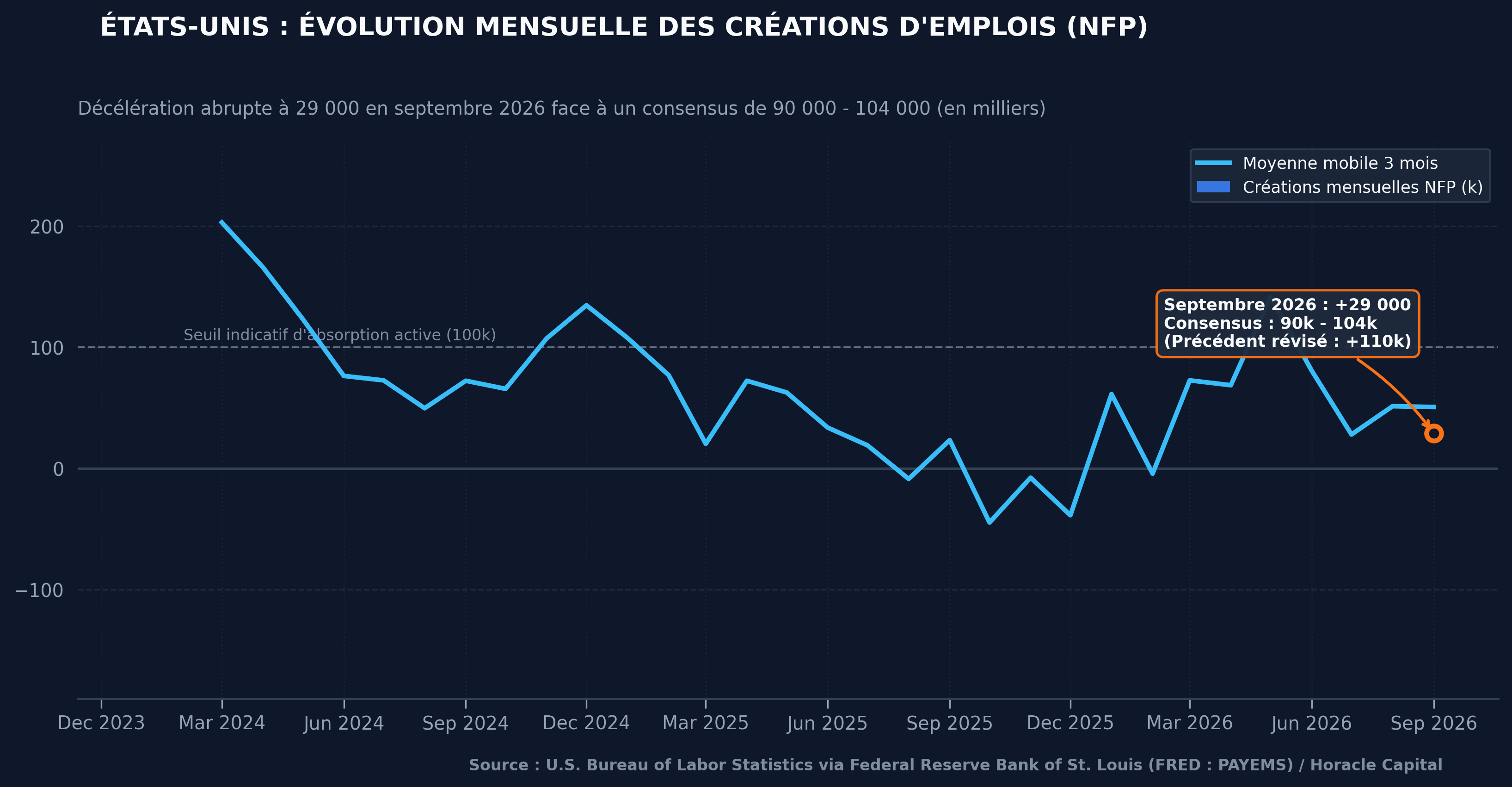
U.S. Nonfarm Payroll additions (NFP): sharp deceleration to +29,000 in September 2026 against a 90,000 - 104,000 consensus. Source: U.S. Bureau of Labor Statistics via FRED API (PAYEMS).
On the fiscal front, federal funding needs continue to test market absorption capacity. Treasury Secretary Scott Bessent adjusted net marketable borrowing estimates to $739 billion for Q3 and $628 billion for Q4, anchoring substantial term premiums across the long end regardless of policy rate shifts.
Euro Area
The European monetary union confronts a stagflationary mix of energy-driven price acceleration and deteriorating sovereign financing conditions across member states.
The flash harmonized inflation print for the euro area significantly overshot projections, printing at 3.8% year-over-year versus 3.2% prior. This acceleration stems directly from the pass-through of natural gas, electricity, and retail fuel costs, vividly illustrated in national figures from Spain (+4.9%) and Germany (+0.5% MoM). While Core inflation held steady at 2.5%, the rapid transmission of freight and energy costs into industrial value chains threatens to contaminate services pricing in the near term.
Monetary authorities at the ECB face contradictory pressures. Bundesbank President Joachim Nagel asserted that energy prices have once again become a dominant driver of policy decisions, keeping rate hike options on the table beyond the 2.65% deposit rate. Conversely, President Christine Lagarde sought to temper hawkish rhetoric by emphasizing vulnerabilities in monetary transmission, thereby removing rate support for the euro against the dollar.
This caution reflects acute strains in European sovereign debt. The German 10-year Bund yield advanced to 3.58%, while French 10-year OAT yields rose sharply to 4.859% in secondary trading. This widening pushed the French-German sovereign spread (OAT-Bund) to nearly 128 basis points, reflecting mounting investor alarm over parliamentary deadlock surrounding the budget bill and the lack of a credible consolidation path. Rising Italian borrowing costs (4.58% at recent BTP auctions) further highlight the narrow margin of safety facing the euro area in an era of quantitative tightening.
United Kingdom
The British macroeconomic environment remains locked in a stagflationary dynamic, marked by weakening consumer spending and persistent wage stickiness.
Second-quarter GDP growth confirmation at 0.4% and a 1.7% rebound in business investment fail to conceal deteriorating household consumption. The monthly CBI retail sales survey plunged to -55 in September, hitting its lowest reading in five months. Retail distribution networks report broad volume declines as consumers absorb cumulative increases in utility and road fuel costs.
The Bank of England held Bank Rate steady at 3.75%, but internal division remains pronounced: a three-member minority on the Monetary Policy Committee continues to vote for an immediate 25 bps hike against headline CPI anchored at 3.1% and wages rising 3.9%.
Market pricing discounting an additional 92 basis points of BoE rate hikes by mid-2027 appears increasingly disconnected from fragile domestic fundamentals. The expectation of a dovish reassessment weighs on sterling against the dollar, while anchoring EUR/GBP in a tight 0.8550 to 0.8600 channel with implied volatility dropping to multi-year lows.
Japan
Japan continues its historic policy normalization, with the Bank of Japan seeking to mitigate financial distortions created by a structurally depressed yen against Western currencies.
Japanese industrial output demonstrated unexpected resilience, with preliminary August production rising 1.4% MoM, lifted by electronic components and semiconductor equipment tied to global AI infrastructure demand. Concurrently, quantitative tightening continues as the monetary base contracts at a 15.2% annual rate.
The policy rate increase to 1.25%, an interest rate level unseen since 1995, is generating direct repercussions across the JGB curve. The 10-year yield has anchored around 3.00%, while the 30-year maturity touched 4.08% at auction, raising national debt servicing costs and pressuring institutional bond holdings.
Despite domestic tightening, the nominal and real yield gap favoring the United States keeps USD/JPY volatile between 155.50 and 159.00. Ministry of Finance officials have reiterated intervention warnings and conducted rate checks with currency desks, establishing the psychological 160.00 line as a primary line of defense.
Cette analyse a-t-elle été utile à votre allocation ?
Attribuez une note de 1 à 5 étoiles (réservé aux membres Horacle Capital).

Léo Lombardini
Trader, Economics & Quant
Passionate about market analysis and statistical modeling, Léo oversees the strategic allocation of the model portfolio and the development of Horacle Capital's quantitative frameworks, as well as writing weekly articles.
Learn more about the author →Go further with our models
Get the weekly biases of our models by email, or open the full platform.