

Global Context
The international macroeconomic landscape is undergoing an abrupt tightening driven by the combination of an energy supply shock in the Middle East and a synchronized second wave of monetary tightening by major Western central banks. Escalating military tensions across the Persian Gulf, marked by tanker attacks and the prolonged shutdown of the Saudi East-West pipeline with a capacity of 7 million barrels per day, has propelled Brent crude toward 105 to 110 dollars, while diesel refining crack spreads have surged beyond 80 dollars per barrel. Simultaneously, European natural gas prices on the TTF contract remain elevated above 80 euros per megawatt-hour. Confronted with this physical cost-push shock, the Federal Reserve and the European Central Bank have ruled out any tolerance for imported inflation, delivering policy rate hikes and signaling an insurance rate hike for December 2026, pushing back the onset of any monetary easing to late 2027.
Upcoming Weekly Calendar
◀
Sep 21, 2026 - Sep 28, 2026
▶
Key Central Bank & PMI Week
| Date | Time | Currency | Impact | Event / Indicator | Forecast | Previous |
|---|---|---|---|---|---|---|
| Mon Sep 21 | 17:00 | EUR | ECB President Lagarde Speaks | - | - | |
| 17:05 | CAD | BOC Gov Macklem Speaks | - | - | ||
| Tue Sep 22 | 05:10 | AUD | RBA Gov Bullock Speaks | - | - | |
| 13:00 | EUR | ECB President Lagarde Speaks | - | - | ||
| Wed Sep 23 PMI Day | 09:15 | EUR | French Flash Manufacturing PMI | 50.9 | 51.1 | |
| 09:15 | EUR | French Flash Services PMI | 48.4 | 48.0 | ||
| 09:30 | EUR | German Flash Manufacturing PMI | 54.0 | 54.3 | ||
| 09:30 | EUR | German Flash Services PMI | 49.9 | 49.7 | ||
| 10:30 | GBP | UK Flash Manufacturing PMI | 51.4 | 51.7 | ||
| 10:30 | GBP | UK Flash Services PMI | 52.0 | 52.5 | ||
| Thu Sep 24 SNB Day | 03:30 | AUD | Employment Change Australia | 20.9K | -15.8K | |
| 03:30 | AUD | Unemployment Rate Australia | 4.5% | 4.5% | ||
| 09:30 | CHF | SNB Monetary Policy Assessment | - | - | ||
| 09:30 | CHF | SNB Policy Rate | 0.00% | 0.00% | ||
| 10:00 | CHF | SNB Press Conference | - | - | ||
| 14:30 | CAD | Core Retail Sales Canada monthly | -0.5% | 0.5% | ||
| 14:30 | CAD | Retail Sales Canada monthly | -0.8% | 0.6% | ||
| 14:30 | USD | US Unemployment Claims | 201K | 196K | ||
| Fri Sep 25 | 11:15 | GBP | BOE Gov Bailey Speaks | - | - | |
| 16:00 | USD | Revised UoM Consumer Sentiment | 47.5 | 47.8 | ||
| 16:00 | USD | Revised UoM Inflation Expectations | - | 4.6% |
Horacle Hub FX Sentiment
EF - Forex : Horacle Hub Edge Finder
G10 Scoring • September 21, 2026
| Asset | Overall | Δ 1S | Verdict |
|---|---|---|---|
|
FX
🇬🇧 🇨🇭
GBPCHF
★
|
+7
|
+4
Bullish Accel
|
STRONG BULL |
|
FX
🇺🇸 🇨🇭
USDCHF
★
|
+5
|
+3
Bullish Accel
|
BULLISH |
|
FX
🇬🇧 🇯🇵
GBPJPY
★
|
+5
|
+4
Bullish Accel
|
BULLISH |
|
FX
🇨🇦 🇯🇵
CADJPY
★
|
+5
|
+4
Bullish Accel
|
BULLISH |
|
FX
🇨🇦 🇨🇭
CADCHF
★
|
+5
|
+4
Bullish Accel
|
BULLISH |
|
FX
🇪🇺 🇨🇭
EURCHF
★
|
+4
|
+6
Short Covering
|
BULLISH |
|
FX
🇦🇺 🇨🇦
AUDCAD
★
|
-4
|
-4
Bearish Accel
|
BEARISH |
|
FX
🇳🇿 🇨🇭
NZDCHF
★
|
+4
|
+2
Bullish Accel
|
BULLISH |
Currencies & Central Banks
US Dollar
The US dollar stands as the primary structural beneficiary of this macroeconomic regime, backed by relative domestic energy independence and wide nominal and real yield differentials. The Federal Open Market Committee, the FOMC, raised its target range to 4.00 % at its recent policy meeting, with market pricing now formalizing an additional 25 basis point insurance hike at the December 9, 2026 meeting toward a terminal rate of 4.25 %, followed by an extended plateau through 2027.
Sustained strength in August retail sales confirmed domestic demand resilience, while core PCE inflation at 3.3 % and headline PCE at 3.7 % signal that converging toward the 2.0 % objective requires persistent financial tightness. Investors will monitor weekly unemployment claims scheduled at 201K on Thursday September 24, alongside revised University of Michigan consumer sentiment on Friday September 25. The latter will command close attention from the Federal Reserve as long-term inflation expectations hover at 4.6 %, ruling out premature policy easing. In sovereign debt markets, the US 10-year Treasury yield trades near 5.00 % with technical targets pointing toward 5.10 % and 5.25 %, propelled by record sovereign issuance volumes and tech corporate debt offerings. The buyback operation conducted by Treasury Secretary Scott Bessent, executing only 5.19 billion dollars against the 6 billion target, dismantled expectations of an official cap on long-term yields, allowing term premium expansion and compressing the 2-year to 10-year curve below 30 basis points while guiding the DXY dollar index toward 100.00.
Euro
The Eurozone faces an asymmetric supply shock due to structural import dependency and domestic fragility. With liquefied natural gas cargoes through the Strait of Hormuz disrupted, TTF gas holding above 80 euros per megawatt-hour threatens European industry while European Union storage facilities sit at 68 % capacity, below the five-year average of 84 % and falling short of the 75 % regulatory winter threshold.
The European Central Bank raised its deposit rate to 2.50 % and signaled another 25 basis point hike in December 2026 to reach 2.75 %, attempting to protect the currency and defend its anti-inflation credibility. Speeches from Christine Lagarde on Monday September 21 and Tuesday September 22 will provide key guidance ahead of Wednesday’s Flash PMIs, where service sector activity is forecast in contraction in France at 48.4 and stall speed in Germany at 49.9. Raising interest rates against an exogenous supply shock accelerates consumption contraction and erodes manufacturing margins, reinforcing a stagflationary regime for the single currency. On European bond desks, the 10-year German Bund yield climbed toward 3.25 % with scope for 3.50 %, but the primary dislocation lies in sovereign credit spreads : the 10-year French OAT to German Bund spread widened to 96 basis points, marking its highest level since the 2012 sovereign debt crisis. Political frictions surrounding the 2027 budget proposed by Prime Minister Sébastien Lecornu to contain the deficit to 5.0 % of gross domestic product, combined with upcoming rating decisions from Scope and DBRS, enforce ongoing downside pressure on EUR/USD toward 1.1400 and 1.1350.
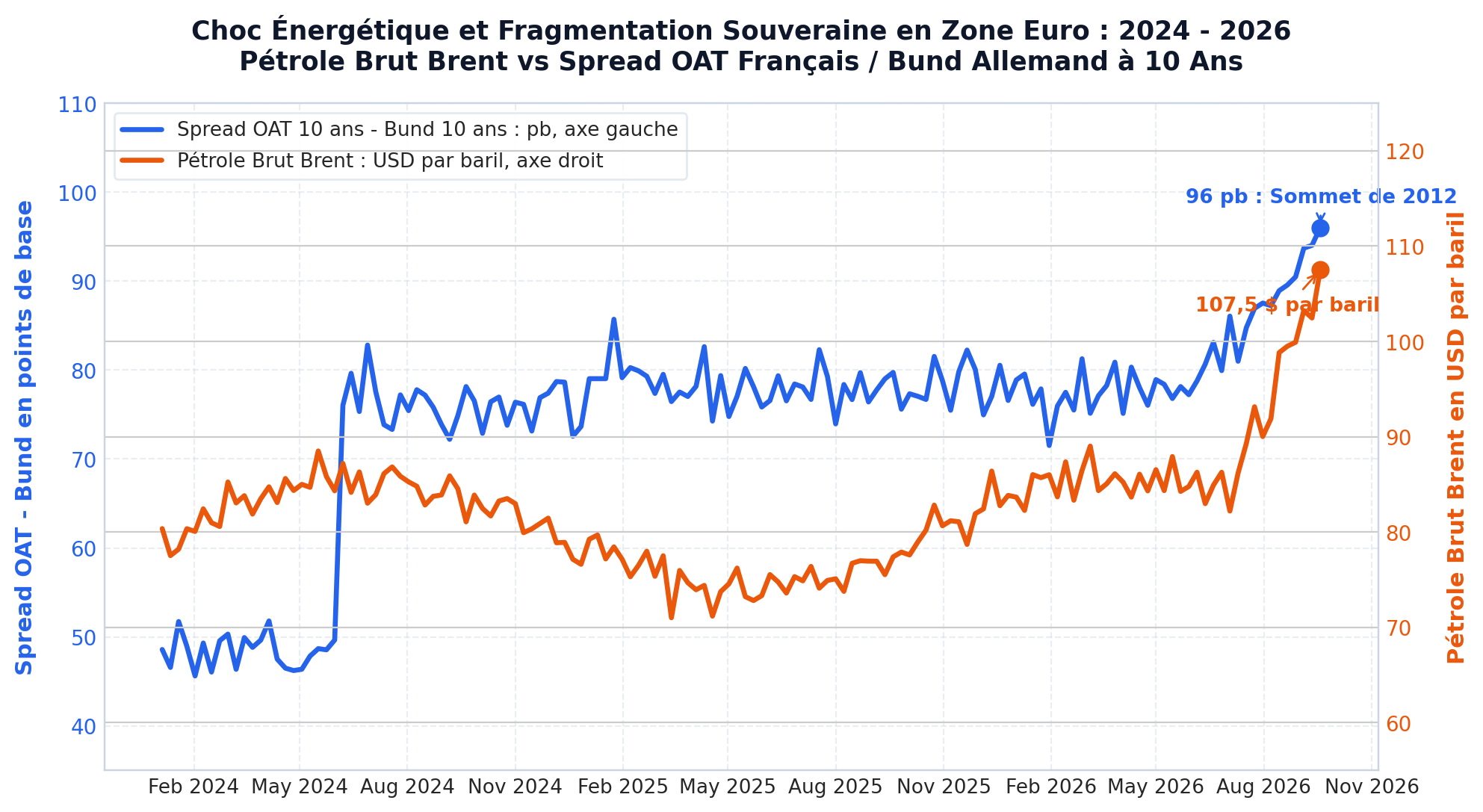
Evolution of the 10-year French OAT to German Bund yield spread alongside Brent crude oil : transmission of energy supply shocks to European sovereign risk.
British Pound
The Bank of England maintains a diverging stance relative to the hawkish posture of Washington and Frankfurt. While headline inflation rebounded to 3.1 % on energy tariffs, core components remain anchored and private sector wage growth decelerated to 3.0 % year-on-year compared to 6.0 % two years prior, a rate consistent with the medium-term inflation target. Governor Andrew Bailey pushed back against aggressive tightening expectations, confirming that the policy rate reached its cycle peak at 3.80 % with a protracted hold expected into the third quarter of 2027. Traders will watch his speech on Friday September 25 and Flash PMIs on Wednesday September 23, where services remain expansionary at 52.0.
Operationally, the central bank reorganized its Quantitative Tightening program by ring-fencing approximately 120 billion pounds of sovereign debt maturing after 2049, removing long-dated gilts from active auctions until April 2027 via short-dated Treasury asset swaps. While this tactical shift triggered yield relief across 30-year gilts, the 10-year gilt remains held above 5.00 %, carrying an estimated 20 basis point fiscal risk premium under Andy Burnham’s government. In foreign exchange, the pound sterling exploits its carry advantage against the euro, crushing 3-month EUR/GBP implied volatility below historic levels of 3 % within a 0.8500 to 0.8600 trading band. This relative resilience is validated by Horacle Hub Edge Finder, where GBP/CHF leads the G10 cross ranking with a score of +7 in bullish acceleration.
Japanese Yen
The Bank of Japan lifted its benchmark rate by 25 basis points to 1.25 %, but markets interpreted the outcome as a dovish hike. The policy board revealed internal discord as governors Toichiro Asada and Ayano Sato, close to Prime Minister Sanae Takaichi, cast dissenting votes citing Tokyo core inflation slowing to 1.8 % in August under government utility subsidies. This formal pushback curtails Governor Kazuo Ueda’s capacity to guide rates toward an estimated neutral level of 2.00 %.
Currency desks swiftly penalized the lack of policy commitment, pushing USD/JPY to 157.11 and reopening an extension toward 160.00. The yield spread against US 10-year Treasuries reignited the carry trade funded in yen, confirmed by Edge Finder bullish readings on GBP/JPY at +5 and CAD/JPY at +5. Furthermore, Japan’s total reliance on energy imports weakens its current account balance as Brent holds above 105 dollars. Finance Minister Satsuki Katayama’s verbal warnings offer limited defense : official foreign exchange reserves approach the 1 trillion dollar threshold, and International Monetary Fund guidelines restricting direct currency interventions to three occurrences per six-month window deprive authorities of sustainable ammunition.
Australian Dollar
For the Australian dollar, market trajectory is anchored to the K-shaped economic divergence in China. In mainland China, subdued domestic consumption reflected in 0.4 % retail sales growth and a 19.9 % contraction in real estate investment suppress demand for industrial commodities and iron ore. With the People’s Bank of China leaving Loan Prime Rates unchanged at 3.45 % and 3.95 % to shield commercial banking margins, credit expansion remains limited.
The Reserve Bank of Australia must calibrate policy between regional trade headwinds and sticky domestic inflation. Governor Michele Bullock speaks on Tuesday September 22 ahead of Thursday’s employment release, expected to show 20.9K job gains and an unchanged 4.5 % unemployment rate. While Australia’s net export position in liquefied natural gas and coal provides insulation against higher energy costs, it lags behind crude oil producers : Edge Finder highlights this divergence with a -4 score on AUD/CAD in bearish acceleration, while the Aussie preserves tactical outperformance against European and Asian net energy importers.
New Zealand Dollar
The New Zealand dollar displays heightened vulnerability relative to its Australian counterpart. The domestic economy bears the lagged strain of historical policy tightening, characterized by sluggish household consumption and rising unemployment. Persistent weakness in export prices for dairy and agricultural products directly erodes export receipts and undermines the nation’s terms of trade.
Moderating inflation has led the Reserve Bank of New Zealand to cap its policy rate, narrowing the yield cushion that historically supported the currency. Against a backdrop of tight global dollar liquidity and elevated US term premia, global capital allocates toward deeper and higher-yielding alternatives. This macroeconomic setup supports ongoing underperformance in NZD/USD and persistent upside in AUD/NZD, while the Swiss franc’s funding profile allows NZD/CHF to hold a +4 bullish score in our model.
Swiss Franc
The Swiss National Bank approaches a pivotal milestone on Thursday September 24 with its quarterly monetary policy assessment, with the policy rate anticipated unchanged at the 0.00 % floor. This wide yield differential against G10 peers firmly positions the franc as the primary funding currency for global carry trades. Institutional desks borrow Swiss francs to fund long positions in sterling, US dollars, and Canadian dollars, driving high scores on GBP/CHF at +7, USD/CHF at +5, and CAD/CHF at +5 in Edge Finder.
The subsequent press conference will reveal whether Swiss policymakers contemplate foreign exchange interventions to curb imported energy inflation. Periodic geopolitical flare-ups in the Middle East and sovereign spread widening in Europe restore safe-haven flows to the franc against the single currency. Although EUR/CHF experienced short covering of +6 points, the structural downtrend remains intact under European fiscal and energy vulnerability.
Commodities
In commodity markets, Brent crude consolidates between 105 and 110 dollars per barrel due to transport bottlenecks across the Strait of Hormuz and the shutdown of the Saudi East-West pipeline. This physical constraint is reinforced by severe distillate tightness, pushing European diesel crack spreads beyond 80 dollars per barrel. The Canadian dollar captures these energy terms of trade gains, offsetting an expected -0.8 % decline in Canadian retail sales on Thursday September 24 and driving CAD/JPY and CAD/CHF to +5 in Edge Finder. European Title Transfer Facility natural gas holds above 80 euros per megawatt-hour, reflecting winter supply anxiety as European Union storage remains capped at 68 %.
In contrast to hydrocarbons, base metals show divergence. London Metal Exchange copper struggles to extend upward momentum, weighed down by contraction in Chinese real estate and prospective manufacturing slowdowns induced by global monetary restriction. In precious metals, gold balances between safe-haven hedging demand and the opportunity cost of US 10-year yields holding near 5.00 % alongside multi-year highs in real yields.
Sovereign Bonds
Across global debt markets, 10-year US Treasury yields test the psychological 5.00 % barrier, driven by rising term premia, the absence of an official yield cap, and large sovereign and tech issuance programs. The US yield curve exhibits bear flattening pressure with the 2-year to 10-year spread narrowing below 30 basis points, facing additional verification from University of Michigan inflation expectation prints on Friday.
In Europe, the 10-year German Bund yield trades near 3.25 % heading toward 3.50 %, but investor scrutiny is focused on sovereign fragmentation. The 10-year yield spread between French OATs and German Bunds expanded to 96 basis points, marking its widest gap since the 2012 crisis, fueled by parliamentary debates over the 2027 budget and impending sovereign rating reviews from Scope and DBRS. In the United Kingdom, the 10-year gilt remains above 5.00 % with an embedded fiscal risk premium, contrasting with the yield compression across 30-year maturities engineered by the Bank of England’s selective Quantitative Tightening adjustment.
Cette analyse a-t-elle été utile à votre allocation ?
Attribuez une note de 1 à 5 étoiles (réservé aux membres Horacle Capital).

Léo Lombardini
Trader, Economics & Quant
Passionate about market analysis and statistical modeling, Léo oversees the strategic allocation of the model portfolio and the development of Horacle Capital's quantitative frameworks, as well as writing weekly articles.
Learn more about the author →Go further with our models
Get the weekly biases of our models by email, or open the full platform.