

Global Context
The end of September 2026 cements the clear dominance of the U.S. dollar across the foreign exchange market. The DXY index climbed above 100.50 to test 100.65, with major technical resistance at 101.00 firmly in sight. This rally is powered by a pronounced cyclical divergence between the United States and other developed economies, alongside a broad-based surge in global sovereign bond yields: the U.S. 10-year yield crossed 5.00% to test 5.10% (with ING modeling potential upside extension toward 5.25% - 5.50%), while the 10-year German Bund rose to 3.58%, its highest level since the 2009 financial crisis.
Amid ongoing naval disruptions in the Strait of Hormuz where tanker volumes remain halved (10 million barrels per day versus 20 million in baseline conditions), America’s net energy exporter status provides the greenback with structural insulation from rising hydrocarbon costs, whereas European and Asian currencies suffer severe terms-of-trade deterioration.
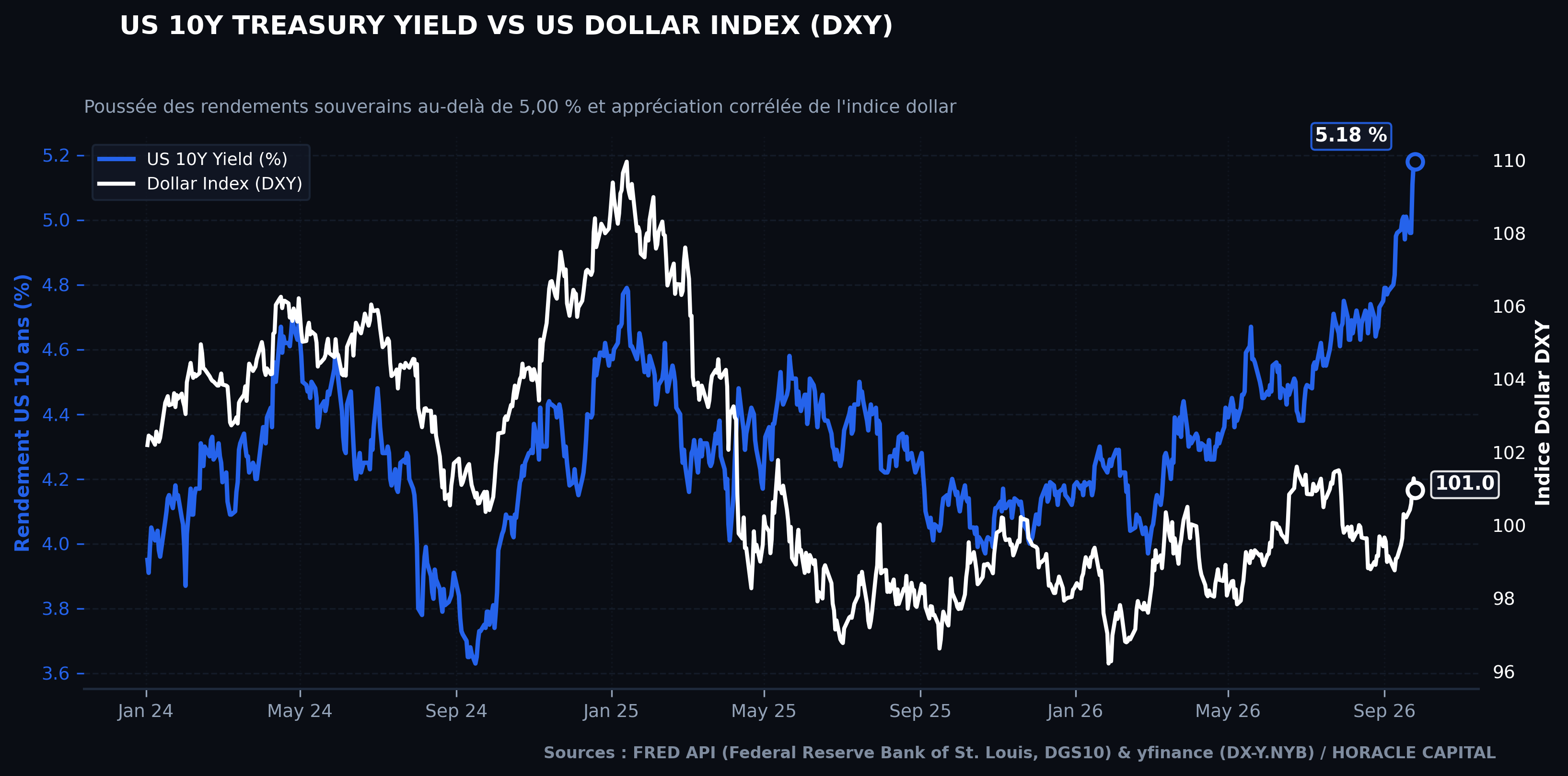
Comparative trajectory of the 10-year U.S. Treasury yield (5.10%) and the DXY Dollar Index (100.65). Sources: FRED API (DGS10) and yfinance (DX-Y.NYB).
Dollar
The U.S. dollar has established itself as the premier safe-haven and carry asset of the current international cycle. The American economy continues to exhibit remarkable momentum: the S&P Global Flash Composite PMI for September printed at 58.4 (comfortably beating the 55.8 consensus and 56.0 prior), marking its fastest expansion pace since July 2021. The services component surged to 58.7, while manufacturing returned to solid expansion at 57.0 against a 53.6 forecast.
In the labor market, weekly initial jobless claims dropped to 197,000, besting the 204,000 expected and confirming the absence of labor market attrition. Durable goods orders held steady at 0.0% in August (-0.3% expected), rising 0.3% excluding transportation. However, pipeline price pressures are building due to fuel, ocean freight, and wage gains. The final University of Michigan survey revealed household inflation expectations rising to 4.6% on a 1-year horizon and 3.4% at 5 years, highlighting risks of de-anchoring.
This resilient backdrop reinforces the restrictive stance of the Federal Reserve under Chair Kevin Warsh. Following the policy rate hike to 4.00%, hawkish comments from Beth Hammack (Cleveland Fed, warning that an inflationary mindset risks becoming embedded), Thomas Barkin, and Alberto Musalem indicate current financial conditions are not sufficiently tight to curtail corporate capital spending. Markets now price a greater than 60% probability of another 25 bps rate hike in October, driving a 20 bps jump in the 2-year SOFR contract. Meanwhile, Treasury Secretary Scott Bessent revised net marketable borrowing projections to $739 billion for Q3 and $628 billion for Q4, producing auction tails on 5-year and 7-year note sales that keep term premiums elevated and support the dollar rally.
Euro
The common currency is confronting rapid deterioration in its equilibrium value. ING’s short-term valuation framework pegs the fair value of EUR/USD below 1.150, clearing a downward path toward key technical supports at 1.1330 and 1.1250.
While Germany saw technical improvement with a Flash Composite PMI of 53.8 (an 11-month high) and the Ifo business climate index rising to 89.9, this rebound is burdened by soaring fuel and gas input costs. In France, macroeconomic conditions are considerably more fragile: although headline PMIs stabilized above 50 (composite at 51.2, services at 51.4), the INSEE business climate indicator slipped to 96, drifting below its long-term average as manufacturers report sustained order backlog declines.
The primary systemic vulnerability lies in French sovereign risk. The 10-year yield spread between French OATs and German Bunds widened to 110 basis points, fueled by political uncertainty surrounding the national budget bill. For the European Central Bank, with its deposit rate at 2.65%, the policy trade-off is intensifying: Bundesbank President Joachim Nagel reaffirmed that energy has reemerged as a central policy determinant, leaving the door open for additional rate hikes. However, market pricing discounting up to 100 bps of further ECB tightening through late 2027 looks difficult to reconcile with sovereign refinancing burdens and the imminent risk of financial fragmentation.
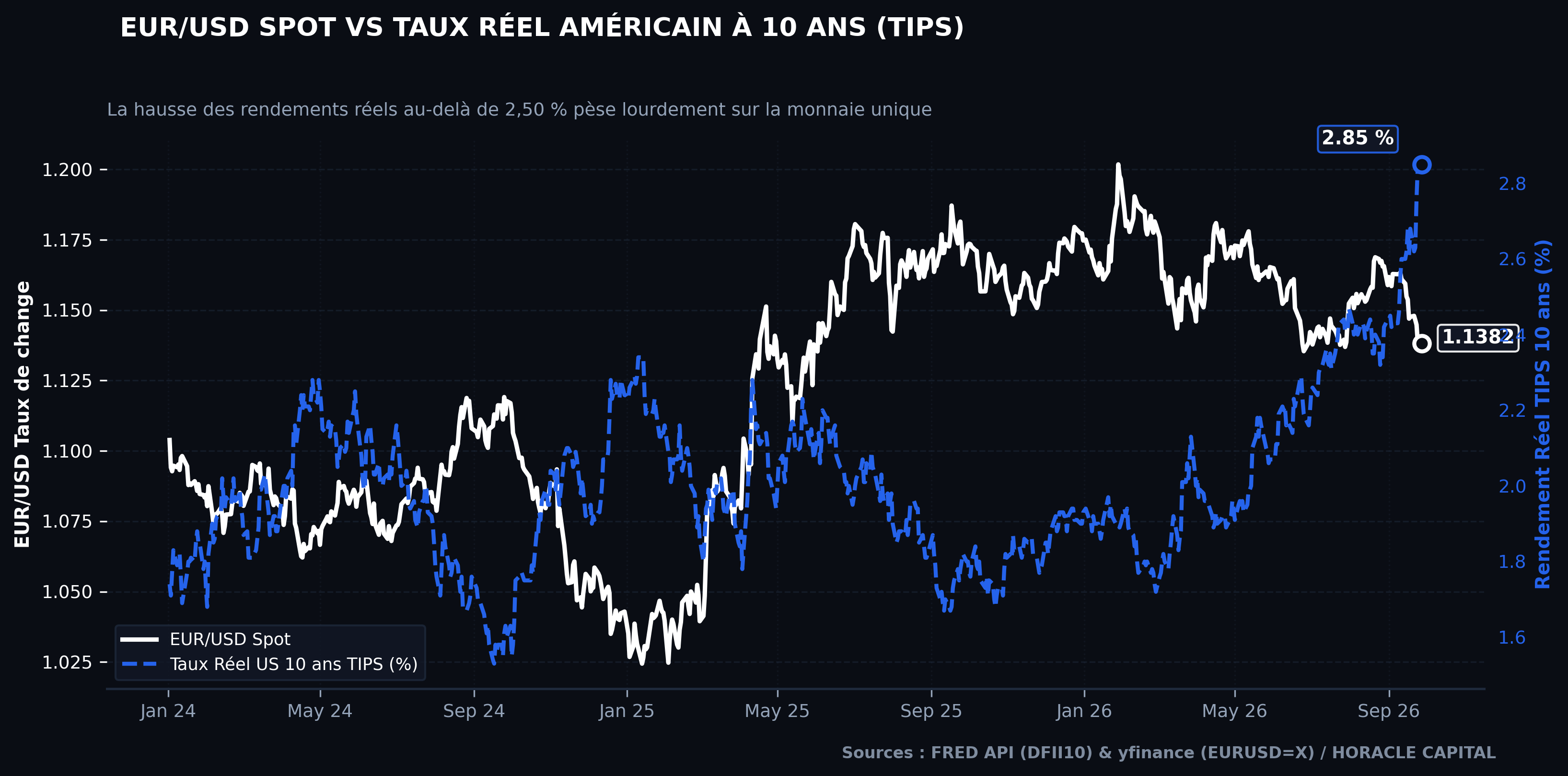
Downside pressure on EUR/USD against rising 10-year U.S. TIPS real yields (2.55%). Sources: FRED API (DFII10) and yfinance (EURUSD=X).
British Pound
Sterling remains caught in a challenging cross-asset dilemma, sliding against the greenback while maintaining a sideways trajectory against the euro (EUR/GBP holding in a narrow 0.855 to 0.860 range). The Bank of England kept Bank Rate unchanged at 3.75%, but the Monetary Policy Committee (MPC) vote revealed deep internal division with a 3-0-6 split: three dissenting members pushed for an immediate 25 bps hike to counter headline CPI inflation at 3.1% (core at 2.6%).
Domestic consumer demand, however, is flashing severe warning signs. The Confederation of British Industry (CBI) retail sales index slumped to -55 in September, marking a five-month low and heavily missing forecasts. While regular weekly earnings growth ex-bonuses remains firm at 3.9%, stretched household balance sheets, elevated mortgage resets, and fiscal tightening make the 92 bps of incremental BoE tightening priced by mid-2027 look unrealistic. This policy gap leaves sterling susceptible to a dovish repricing and downside acceleration versus the dollar.
Japanese Yen
In Japan, the Bank of Japan executed a landmark monetary milestone by hiking its policy rate by 25 basis points to 1.25%, a level unseen since 1995. The rate hike was supported by BoJ Core CPI printing above expectations at 1.8% in August, month-over-month industrial output rising 1.2%, and Q2 corporate capital expenditures expanding 1.6%.
Nonetheless, accelerated policy normalization is unleashing severe upward pressure across the JGB curve: the 10-year yield touched 3.00%, while the 30-year maturity jumped to 4.08% at recent auctions, rekindling concerns over public debt servicing costs. Despite rate hikes, the nominal and real yield gap against U.S. Treasuries remains heavily unfavorable for the yen, compounded by Japan’s ballooning hydrocarbon import bill. USD/JPY is trading in the sensitive 157 to 160 band, prompting Tokyo’s Ministry of Finance to conduct rate checks with settlement banks. Without coordinated physical intervention, the yen remains vulnerable to persistent carry-trade selling.
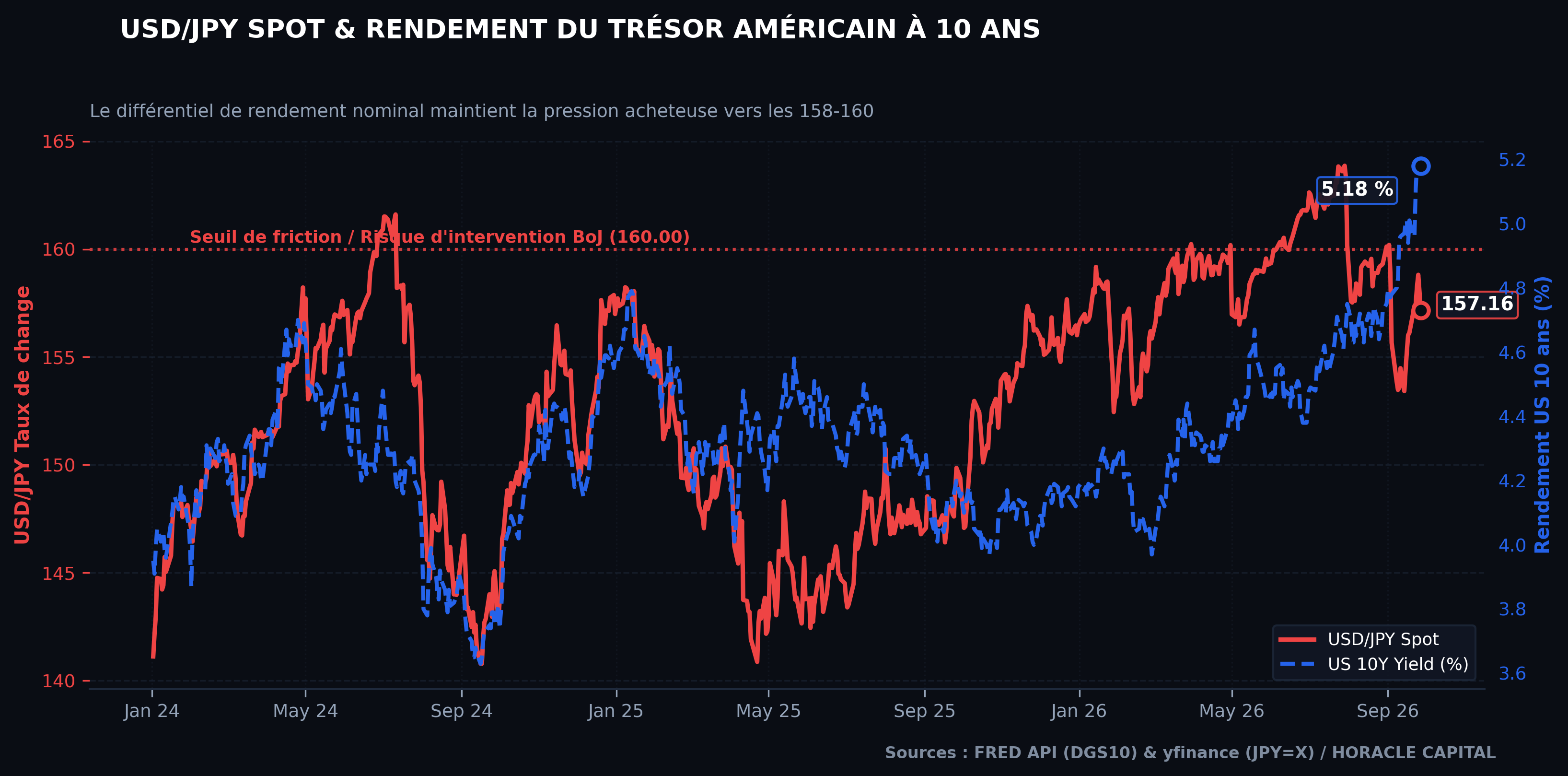
USD/JPY (158.20) vs U.S. 10-year sovereign yield (5.10%): carry dynamics keep the yen under pressure against the dollar. Sources: FRED API (DGS10) and yfinance (JPY=X).
Swiss Franc
The Swiss National Bank reaffirmed its policy rate at 0.00%. With a nominal yield differential exceeding 400 basis points against the U.S. dollar and 350 basis points against sterling, the Swiss franc serves as the primary funding vehicle for international carry trades.
However, the resurgence of euro-area fiscal stress and the widening French OAT-Bund spread to 110 bps periodically drives safe-haven franc bids against the single currency. This dynamic caps EUR/CHF upside above 0.9450, establishing the franc as a sensitive barometer of European sovereign political risk.
Conclusion
The foreign exchange landscape continues to be dictated by asymmetric energy independence and wide real yield differentials. The U.S. dollar consolidates its role as the dominant anchor of the G10 complex, underpinned by resilient domestic activity and the Federal Reserve’s determination to sustain an extended restrictive cycle.
Tactically, short EUR/USD exposure (fading 1.1430 to 1.1450, targeting 1.1330 then 1.1250, with invalidation set on a daily close above 1.1530) represents the most coherent macroeconomic expression against mounting European sovereign risks and imported energy costs. On USD/JPY, positive carry supports maintaining long positioning while closely watching the critical 160.00 threshold where risk of MoF intervention peaks.
Cette analyse a-t-elle été utile à votre allocation ?
Attribuez une note de 1 à 5 étoiles (réservé aux membres Horacle Capital).

Léo Lombardini
Trader, Economics & Quant
Passionate about market analysis and statistical modeling, Léo oversees the strategic allocation of the model portfolio and the development of Horacle Capital's quantitative frameworks, as well as writing weekly articles.
Learn more about the author →Go further with our models
Get the weekly biases of our models by email, or open the full platform.